Great visionary leadership in product development, entrepreneurship, and innovation is often romanticized as an innate gift—a rare spark reserved for the chosen few. The truth is far more practical. Developing a breakthrough product, service, or solution does not require mythical foresight; it requires a structured commitment to direction, communication, and execution.
Anyone attempting to create, build, develop, or launch something new should adhere to these four fundamental principles.
PRINCIPLE #1
It is hard to lead if you don't have a vision of the future.
To build something new, you must first answer a deceptively simple question: Where are we going, and why does it matter? A vision is not a detailed roadmap; it is a clear picture of a better future that does not yet exist. Without this guiding North Star, development efforts inevitably scatter. Teams suffer from feature creep, resources are wasted on conflicting priorities, and the product becomes a disjointed mosaic rather than a cohesive solution.
When establishing this direction, understand that your vision doesn’t have to be great. It doesn’t have to be correct. It doesn’t have to be far off. It doesn’t have to be revolutionary. It doesn’t have to be reasonable. It doesn’t have to be popular. It doesn’t even have to be originally yours.
But it does have to be different.
Very few things remain unchanged, which means product strategy is as much about preparing for the future as it is about capitalizing on the present. Resisting change in a dynamic market inevitably leads to perilous results, with a position of leadership quickly evolving into a case study in obsolescence. Direction precedes traction—and if you fail to look ahead, you will eventually find yourself running in place.
Consider these cautionary tales of companies that focused too much on operating today and not enough on envisioning tomorrow:
Blockbuster – As consumers embraced e-commerce and content streaming, Blockbuster focused on immediate brick-and-mortar profits. They were so blinded by current revenue streams that they passed on the opportunity to acquire Netflix for $50 million in 2000. A decade later, they filed for bankruptcy.
Kodak – As the original inventors of the digital camera, Kodak wasn’t blind to the digital trend. However, they grossly underestimated its potential impact and stubbornly relied on their film-based cash cow for far too long. By the time Kodak decided to meaningfully enter the market, other players like Canon, Sony, and Nikon had already firmly positioned themselves as leaders. Kodak filed for bankruptcy in 2012.
Blackberry – While the mobile industry was shifting toward versatile, software-driven smartphones with all-glass touchscreens and diverse app stores, BlackBerry remained steadfast in its physical keyboard form factor and legacy operating system. When they finally pivoted, the market had moved on, leaving Apple and Android-based devices with an insurmountable lead. BlackBerry’s market share plummeted, and it permanently decommissioned its phone-related infrastructure.
Each of these corporate entities rose to a leading market position by executing on a vision of the future. But when that future effectively became the present, they failed to envision a different future. They found satisfaction in pursuing static operational objectives—making things better, cheaper, faster, more flexible, or more consistent—and refining their current state. In short, they stopped leading. And they were caught completely by surprise when everyone left to follow someone else.
If you want to lead—now and in the future—you must have a vision. Somewhere to point. Something to achieve. Somehow to do it differently.
PRINCIPLE #2
You don't have to be a visionary to lead.
There is a dangerous myth that only people with rare, prophetic foresight can build breakthrough products or lead an industry. We routinely romanticize the “visionary leader” as someone who receives divine, solitary epiphanies about what the world will look like a decade down the line. While visionaries have left an indelible mark on history, the idea that every effective leader must possess this unique trait is a narrow perspective. In fact, it is time to completely challenge the notion that you have to be a visionary to lead successfully.
Often, leading is not about inventing the future out of thin air. It is about astute industry observation, synthesizing the landscape, and executing with relentless precision before anyone else. A quintessential case study of this reality can be found in one of tech history’s most celebrated “visionary” moments.
On Tuesday, January 9, 2001, Steve Jobs took the main stage at Macworld in San Francisco. With more than 5,000 people in attendance and tens of thousands watching around the world via a QuickTime livestream, he began with a standard demo of new features in Mac OS X before shifting to a Power Mac G4 update. Roughly 45 minutes into the presentation, Jobs took advantage of an applause break to walk to the side of the stage for a drink of water. He paused, turned back to the audience, and asserted, “We’re just getting started.”
“I’d like to tell you where we are going,” he offered as a transition. “What is our vision? A lot of people have come to ask that of our whole industry in the last few months: what is our vision?”
The next five minutes would arguably prove to be the most revelatory strategic moment in Jobs’ tenure as Apple CEO. He opened with a summation of how the personal computer had evolved during the previous two decades and asserted the dawn of a new era:
“We are living in a new digital lifestyle with an explosion of digital devices. It’s huge. And we believe the PC, or more importantly the Mac, can become the digital hub of our new emerging digital lifestyle, with the ability to add tremendous value to these other digital devices.”
Steve Jobs
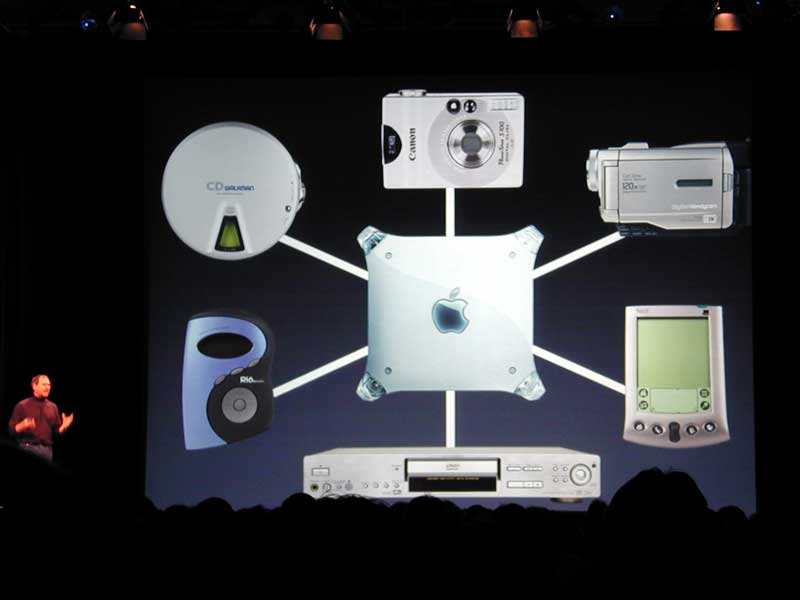
Jobs then elaborated on this concept of the “Digital Hub”—the foundational idea that the computer would serve as the central anchor connecting digital cameras, camcorders, and MP3 players. Over the subsequent years, Apple fleshed out this vision with products like the iPod and iPhoto. A decade later, the Digital Hub strategy was hailed as the dawn of Apple’s absolute dominance, as revenues climbed from $6.5 billion to $42 billion over eight years—a 550% increase. Jobs was widely canonized as the visionary leader whose prophetic idea single-handedly defined modern computing.
But the idea wasn’t originally his.
Exactly one year earlier, at the January 2000 Consumer Electronics Show (CES) in Las Vegas, Bill Gates of Microsoft had stood on a stage and asserted a nearly identical thesis:
“The year 2000 ushers in the ‘consumer electronics-plus’ era, a defining moment in computing when software will enable new services and new tools for consumers, simply and easily,” Gates said.
Gates went on to describe a future in which people would seamlessly access their favorite music, books, videos, and communication networks from their homes, cars, and offices across an array of interconnected devices. Microsoft’s entire booth at CES that year centered on this exact theme, depicting people using centralized software to fuel a connected, daily digital lifestyle.
The historical reality is clear: Jobs wasn’t a prophet. And Gates most likely wasn’t either.
Yet despite the clear head start. Microsoft couldn’t execute on Gates’ vision at the time, whereas Apple, under Jobs, moved with incredible speed into the digital lifestyle age, rapidly building out the software and hardware portfolio required to make the concept a reality. Jobs wasn’t a mystical visionary who saw a future no one else could see; he was an incredibly astute industry observer with a keen design eye, deep user empathy, and a masterful understanding of how to convey a direction.
You do not need to invent a brand-new future to lead your team, your product, or your company. You can synthesize a vision by looking at data, listening to customers, and connecting the existing dots in the market in a novel way. It is time to move away from the myth that visionary prophets are the only ones capable of determining the right destination. Leadership isn’t about a magical epiphany; it is about taking ownership of a practical direction, communicating it beautifully, and moving quickly to build it.
PRINCIPLE #3
You must convey your vision in a clear, compelling, and convincing manner.
Your product or service vision is a strategic narrative that outlines the long-term goals and direction of your team, organization, business, or institution. It is a guiding concept that provides a sense of purpose for the development and evolution of whatever it is you do to create value.
However, a dangerous trap for creators is assuming that because a vision is crystal clear to them, it is equally clear to everyone else. Understanding and acceptance can vary wildly among different stakeholders. What seems self-evident and inspiring to a developer might feel abstract or irrelevant to an investor, customer, or executive. For your vision to be effective, it cannot exist in a vacuum; it must be intentionally crafted to resonate across a wide and diverse audience. To bridge this gap and align a fragmented room, your narrative must master three distinct pillars: it must be clear, compelling, and convincing.
The absolute masterclass in this framework occurred on September 12, 1962, when President John F. Kennedy stood before a crowd of 40,000 people at Rice University Stadium. The United States was lagging behind in the Space Race, national morale was fractured, and the technological infrastructure required to reach space barely existed. Kennedy first proposed the lunar landing goal a year and a half earlier during an address to a Joint Session of Congress; however, that was a legislative policy and budget demand. The speech at Rice was a poetic cultural rallying cry that turned a cold political competition into an inspiring human crusade.
“We choose to go to the Moon. We choose to go to the Moon in this decade and do the other things, not because they are easy, but because they are hard; because that challenge is one that we are willing to accept, one we are unwilling to postpone, and one which we intend to win...”
President John F Kennedy
Kennedy’s address didn’t just share an operational objective; it etched a permanent vision into the global consciousness by executing flawlessly across all three communication pillars:
Clear: Great visions strip away complex jargon and ambiguous fluff, as Kennedy did with the statement above. He didn’t say, “We will optimize our thermodynamic and aerospace engineering matrix to achieve lunar orbit dominance.” He gave a concrete, simple image that an elementary school student could instantly visualize: We will land a man on the moon, and we will bring him back safely, before this decade is out. It left zero room for misinterpretation.
Compelling: To move people to action, a vision must tap into the emotional and philosophical reality of why the journey matters. Kennedy beautifully elevated the mission from a mere geopolitical competition to an inevitable step in human evolution. He turned a grueling engineering problem into an inspiring test of human resolve.
Convincing: A vision cannot simply be a wishful daydream; it must feel realistically achievable. Kennedy didn’t gloss over the staggering risks or the unprecedented engineering feats required. He openly detailed the sheer physics of the problem—describing a giant rocket made of untried metal alloys, hitting speeds of over 25,000 miles per hour, and controlled by propulsion systems more precise than any instrument ever built. By openly acknowledging the immense mountain to climb, he grounded the goal’s audacity in logical, actionable reality.
When you successfully craft and deliver a narrative that satisfies these three pillars, it transforms your development journey from a chaotic grind into a structured march forward. A truly articulated vision unlocks four critical operational advantages:
Aligns Development Teams – It provides a shared understanding of the product’s ultimate purpose and the core problems it aims to solve. This alignment fosters efficient collaboration and ensures everyone is moving in the exact same direction.
Sparks Creativity and Innovation – When team members are inspired by a shared destination rather than micro-managed tasks, they are far more likely to think outside the box, explore new possibilities, and push boundaries.
Attracts and Retains Top Talent – High-performers are actively drawn to teams and organizations where they can contribute to a meaningful shared purpose, fostering a positive and dynamic work environment.
Resonates Deeply with Consumers – It clearly and cleanly communicates the value proposition. When customers understand how a product addresses their deep-seated needs or desires, they are more likely to engage with it and become loyal advocates.
The importance of making your vision clear, compelling, and convincing cannot be overstated. It serves as the cornerstone for successful development, drives effective marketing, and positions you for long-term success. It is not just about creating a vision; it is about crafting a strategic narrative that captivates, inspires, and propels you toward a future of triumph.
PRINCIPLE #4
You should stubbornly commit to your vision, but not to your plan or tactics.
The destination is fixed; the route is highly negotiable. When launching a product or service, you will inevitably encounter unexpected market shifts, technical roadblocks, and brutal user feedback. True leaders understand that winning requires being rigidly obsessed with the ultimate destination (the vision) while remaining completely detached from the specific map they drew to get there (the tactics).
Crucially, creators must learn to distinguish between a change in vision and a change in approach, process, or action. A strategic pivot does not require or necessitate a change in your vision. Instead, a pivot is a calculated shift in execution designed to find a more viable path toward that exact same vision.
The story of Instagram stands as the definitive modern blueprint for this distinction.
In 2010, Kevin Systrom and Mike Krieger launched a location-based mobile app called Burbn. The app was incredibly complex—it allowed users to check into locations, earn points for hanging out with friends, post plans, and share photos. After months of development, the data and user feedback revealed a harsh reality: the app was too cluttered, the check-in mechanics failed to gain traction, and users found the interface deeply confusing.
Had Systrom and Krieger been stubbornly committed to their plan, they would have doubled down on Burbn. They would have spent more venture capital marketing the check-in features, tweaking the point system, or forcing a flawed product onto an indifferent market. Instead, they stepped back and looked at their core vision. Their ultimate North Star wasn’t to build a check-in app; their vision was to give people a simple, beautiful way to share their daily lives visually with the world.
They realized that while their initial tactic (Burbn) was a failure, their vision was still entirely correct. When they looked closely at user behavior, they noticed that people were largely ignoring the check-in functions and instead utilizing the app’s basic photo-sharing and filtering capabilities.
So, they ruthlessly scrapped the entire plan. They stripped away the check-in mechanics, the point systems, and the complicated social plans. They kept only one core element that served the vision: photo sharing. They re-architected the entire approach into a streamlined, three-click photo-sharing experience and renamed it Instagram. Within hours of its relaunch, the app exploded, eventually scaling to billions of users and a $1 billion acquisition by Facebook just two years later.
Instagram’s legendary pivot was not a change in vision. The vision—helping people visually share their lives—remained perfectly intact from day one. What changed was the approach, the process, and the action.
When your data tells you a specific feature is failing, or when a marketing plan falls flat, you are experiencing a tactical failure, not a visionary one. Pivot the feature, discard the plan, or alter the execution—but do not abandon the mission. Be rigid about the what and the why, but remain beautifully fluid about the how.
Building something out of nothing is inherently chaotic. The “Visionary Manifesto” is designed to act as your strategic anchor.
- Have a vision of the future, ensuring your strategy prepares for tomorrow rather than just operating today.
- Reject the myth of the born prophet, knowing that you can synthesize a great direction through deep market observation and swift execution.
- Master the strategic narrative, ensuring your message is clear, compelling, and convincing across a diverse room of stakeholders.
- Remain stubbornly committed to your destination, treating your plans and tactics as highly negotiable experiments.
By anchoring your innovation and development journey in these four truths, you ensure that your team remains perfectly aligned, your execution remains remarkably adaptable, and your final solution genuinely changes the world for your users.
Now, define your future, align your team, and start building.